
Many people preparing for the SIA Door Supervisor exam make the same mistake: they treat revision as something to read rather than something to practise.
Reading your course materials is important, but passing an exam requires more than recognising information on a page. You need to be able to recall key points, understand scenarios and answer questions confidently under time pressure.
This guide explains how the Door Supervisor qualification is structured, where candidates commonly struggle and how to build an effective revision plan before your assessment.
How the exam is structured
The Door Supervisor qualification is divided into four main areas:
- Principles of Working in the Private Security Industry
- Principles of Working as a Door Supervisor in the Private Security Industry
- Application of Conflict Management in the Private Security Industry
- Application of Physical Intervention Skills in the Private Security Industry
Assessment usually includes multiple-choice examinations alongside practical assessments. The exact assessment format depends on the awarding organisation and training provider.
Each unit must be successfully completed. A strong performance in one area does not make up for failing another, so balanced preparation across all modules is important.
Success is the sum of small efforts, repeated day in and day out. — Robert Collier
Where candidates commonly lose marks
Most candidates do not struggle because they have never seen the information before. They struggle because they have not practised applying it.
Common problem areas include:
Similar definitions
Security exams often test the difference between similar terms. Understanding the exact meaning of legal and professional terminology is important because a small misunderstanding can change the correct answer.
Procedures and correct order
Some questions test whether you understand the correct sequence of actions, such as emergency procedures or how to respond to incidents.
Scenario-based questions
Conflict management questions often present realistic situations and ask what action should be taken. These questions test judgement, communication and understanding rather than simple memorisation.
Scenario-based and sequencing questions can't be answered from memorised definitions alone. They need the kind of practice that comes from working through realistic questions, not just re-reading notes.
Why active revision matters
Reading notes repeatedly can create the feeling that you know the material, but testing yourself is usually a more effective way to identify gaps.
A strong revision routine combines:
- Learning key information from notes
- Testing recall with flashcards
- Practising questions
- Reviewing mistakes
- Completing timed mock exams
A one-week revision plan
If your exam is approaching, this structure can help organise your preparation:
Days 1–3: Build your knowledge
Work through each module carefully. Use flashcards after studying each topic to check what you can remember without looking at your notes.
Days 4–5: Test yourself
Complete topic quizzes and focus on understanding why answers are correct or incorrect. Reviewing mistakes is one of the most valuable parts of revision.
Day 6: Practise under exam conditions
Complete timed mock exams without notes or distractions. This helps build confidence with question style, timing and exam pressure.
Day 7: Final review
Focus on weaker areas, review key facts and avoid trying to learn large amounts of new information the day before your exam.
days_4_to_5: "topic quizzes + review mistakes"
day_6: "full timed mock exams"
day_7: "final review, weaker areas only"
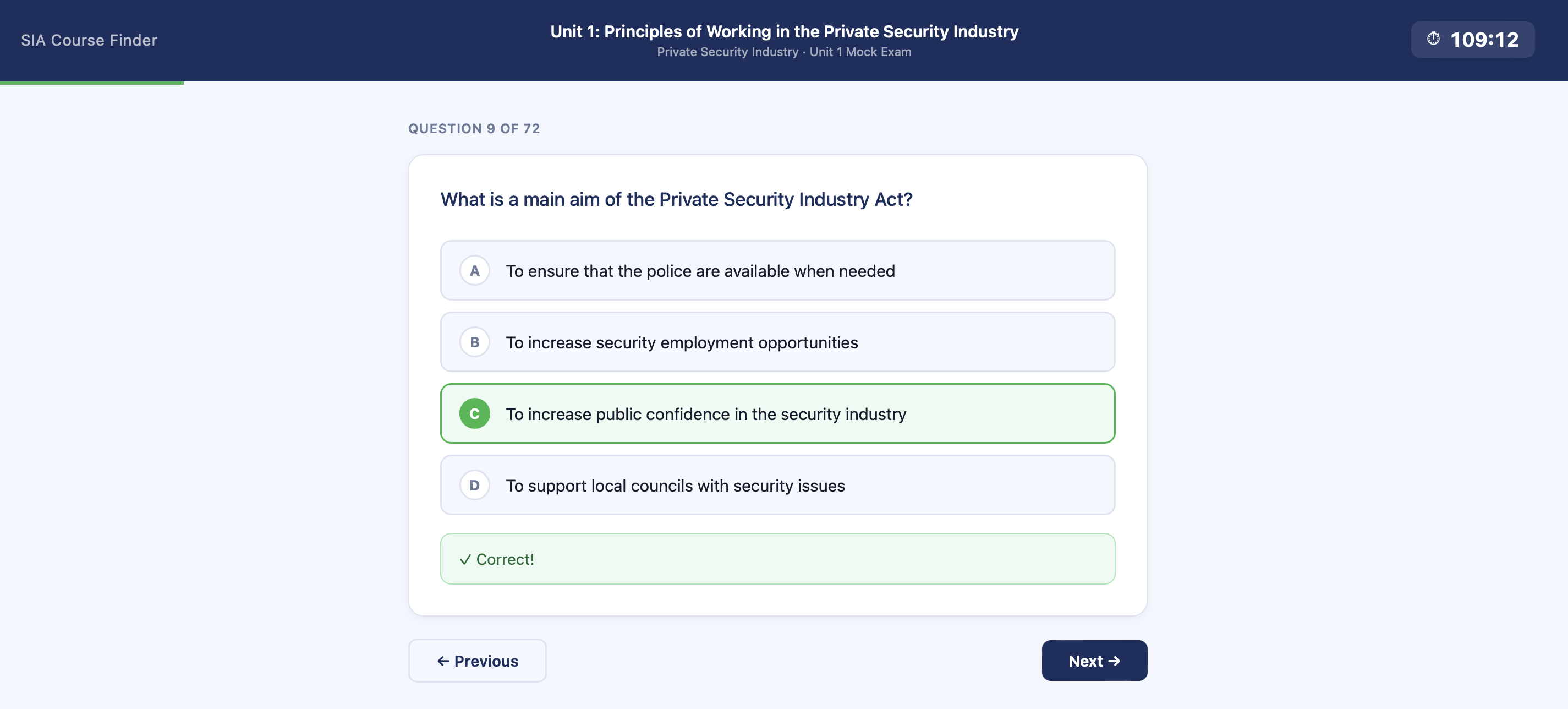
Practise with real exam-format mocks
Timed mock exams, instant-marked quizzes and flashcards, all in one dashboard.
What to expect on exam day
Arrive prepared with the required identification and follow the instructions provided by your training centre.
Your assessment environment may include registration checks and rules around personal belongings. Make sure you understand what you need to bring before attending.
During the exam, manage your time carefully. If a question is taking too long, move on and return to it if the format allows.
Practise with SIA Course Finder
SIA Course Finder gives learners access to structured revision materials, flashcards, quizzes and timed mock exams designed to support preparation for the SIA Door Supervisor qualification.
Prepare smarter, track your progress and identify the areas that need the most attention.
Get instant access for £24.99
Lifetime access, no subscription — everything you need in one dashboard.